do they do birthday parties?
Tuesday, August 12, 2008


Wednesday, June 11, 2008
Fellini's Roma
The Camera and the Crowd
In La Dulce Vita, at the miracle in the field, and again in Roma, along the highway, Fellini explores the relationship between the spectator and the spectacle, the camera, the crowd and the conflagration of the Sense-Event. In both extended scenes, there is the camera: many cameras with intersecting gaze; there is the crowd: assembled for an event, and producing of itself an event. The crowd surrounds the camera, invades the camera, and the camera invades the crowd, they are one and the same, in co-habitation. The crowd and the cameras together form a pluralistic, mutating perspective. There is the rain, which implies disruption but in fact pulls together, intersects, merges, heightens - the show must go on. The spectator and the spectacle are one and the same, they merge as a dynamic and disrupted complex. The spectacle collapses in this complex - or perhaps achieves its highest realization. The reactive forces find a way to act their activity, to escape the cycle of reactivity. And here we begin to understand the strange power of the crowd, its consumption and totalization within the spectacle and the path for it to explode its limitations, to virtualize and to proliferate - to speak for itself.
In La Dulce Vita, at the miracle in the field, and again in Roma, along the highway, Fellini explores the relationship between the spectator and the spectacle, the camera, the crowd and the conflagration of the Sense-Event. In both extended scenes, there is the camera: many cameras with intersecting gaze; there is the crowd: assembled for an event, and producing of itself an event. The crowd surrounds the camera, invades the camera, and the camera invades the crowd, they are one and the same, in co-habitation. The crowd and the cameras together form a pluralistic, mutating perspective. There is the rain, which implies disruption but in fact pulls together, intersects, merges, heightens - the show must go on. The spectator and the spectacle are one and the same, they merge as a dynamic and disrupted complex. The spectacle collapses in this complex - or perhaps achieves its highest realization. The reactive forces find a way to act their activity, to escape the cycle of reactivity. And here we begin to understand the strange power of the crowd, its consumption and totalization within the spectacle and the path for it to explode its limitations, to virtualize and to proliferate - to speak for itself.
Species Activity & The Sublime Abortion

Daniel J. Martinez
Self-portrait #9b: Fifth Attempt to clone mental disorder or How one philosophizes with a hammer, After Gustave Moreau, Prometheus, 1868; David Cronenberg, Videodrome, 1981, 2001
Let us call for an autonomous band of architects, nomads clammering for, if nothing else, an excess of capitalism - with architecture as the extreme manifestation of this excess. And through this excess let us explore the anatomy of capitalism's contradictions - the cracks and fissures in the institutional edifice where new beauty and new activity might take hold - driving for the fragmentation, multiplication and proliferation of this edifice as a shattered mirror reflecting itself.
We must not confuse the product of culture with its means. Man's species activity constitutes him as responsible for his reactive forces: responsibility-debt. But this responsibility is only a means of training and selection: it progressively measures the suitability of reactive forces for being acted. The finished product of species activity is not the responsible man himself or the moral man, but the autonomous and supramoral man, that is to say the one who actually acts his reactive forces for being acted. He alone "is able to" promise, precisely because he is no longer responsible to any tribunal. The product of culture is not the man who obeys the laws, but the sovereign and legislative individual who defines himself by power over himself, over destiny, over the law: the free, the light, the irresponsible...This is the general movement of culture: the means disappearing in the product. Responsibility as responsibility before the law, law as the law of justice, justice as the means of culture - all this disappears in the product of culture itself...Culture is man's species activity; but, since this activity is selective, it produces the individual as its final goal, where species is itself suppressed.
- Gilles Deleuze, Nietzsche & Philosophy, p. 137
In history culture takes on a sense which is very different from its own essence, having been seized by strange forces of a completely different nature. Species activity in history is inseparable from a movement which perverts it and its product. Furthermore, history is this very perversion, it is identical to the "degeneration of culture". - Instead of species activity, history presents us with races, peoples, classes, Churches and States. Onto species activity are grafted social organizations, associations, communities of a reactive character, parasites which cover it over and absorb it. By means of species activity - the movement of which they falsify - reactive forces form collectives...Instead of justice and its process of self-destruction, history presents us with societies which have no wish to perish and which cannot imagine anything superior to their own laws...Instead of the sovereign individual as the product of culture, history presents us with its own product, the domesticated man in whom it finds the famous meaning of history: "the sublime abortion" (Nietzche, Beyond Good and Evil, 63), "the gregarious animal, docile, sickly, mediocre being" (Nietzche, Geneology of Morals, 11).
- Gilles Deleuze, Nietzsche & Philosophy, p. 138
Wednesday, June 4, 2008
The Object and the Field
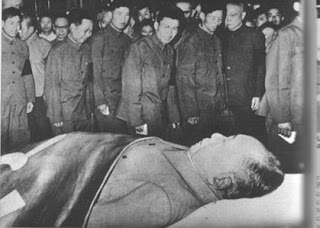
Tiananmen Square and the Body of Mao Zedong
The history of a thing, in general, is the succession of forces which take possession of it and the co-existence of the forces which struggle for possession. The same object, the same phenomenon, change sense depending on the force which appropriate it.
- Gilles Deleuze, Nietzsche & Philosophy
What is Tiananmen Square (as it stands today)? How can we begin to understand it as a manifestation of the cultural and political reality of contemporary China? We might start by saying that it is oceanic. It defined by/in its excessiveness, its openness and its indeterminacy; it is a receptacle for the mobilization of the body-politic. It is composed in the meanderings of the crowd and the systems, overt and covert, that control and orchestrate the behavior of this crowd. It is the site of hyper-surveillance. It is un-centered even as it forms the symbolic center of the nation. It is the seat of power and the diagram of that power, replicated ad infinitum throughout the urban spaces of the country.
The square is subject to a variety of co-existent and at times competing forces. These forces, emanating from symbolic and infrastructural elements placed in and around the square, are both active and reactive, stabilizing and destabilizing, consistent with tradition and a radical departure from that tradition. These forces are encapsulated in the diagram of the site, they define that diagram. In the same sense that the Gothic Cathedral served as a microcosm of the ontological structure of medieval Europe, Tiananmen square operates as a microcosm of the Chinese super-structural reality. The political and cultural imperative of the square and the way in which it represents and broadcasts the authority of that symbolism is dependent on its capacity to operate as a genuine and recognizable microcosm.
Tiananmen square is also the site of the body of Mao Zedong, a phenomenon in itself, replete with its own history of successive possessions and commiserate conformations as a sense-event. Again, it serves both as a stabilizing and destabilizing force in the cultural ecology. The decision to preserve Mao's body and display it in the square must be seen in terms of the Cultural Revolution and the power struggle that followed his death in 1976. Following a series of carefully ritualized events of mourning – and contrary to his apparent wishes to be cremated – Mao's successor, Hua Guofeng announced the decision to construct a monument to house and display Mao's preserved body. This announcement came eighteen days after Mao's death and just two days after Hua's secrete arrest of the radical leftist Gang of Four, primary rivals in the struggle for control of the CCP. Thought by many at the time as politically naive, an empty figurehead subject to the manipulations of various factions of Party leadership, Hua was able to outmaneuver the Gang of Four (and for a time the moderate-reformists led by Deng Xiaoping) by co-opting the symbolic mantle of authority provided by the iconification of Chairman Mao. This move was exemplified by the "Two-Whatevers Campaign" formulating the policy of the Chinese government in the terms of the following statements: "We will resolutely uphold whatever policy decisions Chairman Mao made, and unswervingly follow whatever instructions Chairman Mao gave." Hua understood the direct and perhaps indelible association between Mao and the apparatus of state power, that there was no state without Mao. The act of preservation was a symbolic gesture with a far greater reach, implicating and facilitating a systemic concretization of the Party institutions in transition. The state was stabilized in the enduring image of Mao, on display for all to see. This had very specific effects on the diagram of Tiananmen square. Quite contrary to Mao's ideology of the perpetual revolution and, it must be imagined, the overt intentions of the designers, "the building interrupted the continuities of the square. Symbolically, the unending flow of temporal change...was blocked and then truncated. The mausoleum seemed to seal off history rather than enlarge it." In this sense, the monument became a stabilizing force, fixing the agency of the square in history.
Perhaps, however, we should look at preservation of Mao's body in a different light, held apart from the from the impact of the memorial architecture to the square. In a fascinating discussion, A.P. Cheater explores the symbolic implications of the body and the memorial in the context of traditional burial rites, customs, superstitions and propriety, in other words the cultural imaginative of death. In particular, he questions the anthropological narrative implied in Mao's edifice: "Why...is Mao's final resting place...referred to as a 'memorial hall' [jiniantang]? Has it perhaps to do with the ambiguity, in Chinese funerary custom, of permanent preservation of the flesh, as opposed to the bones? Is Mao dead, or alive, or ambiguously neither – the perfect joker defying normal classification, Monkey, forever? In the old taboo of words, has death – at least for Mao – become almost anti-socialist" Who is this 'joker', this 'Monkey, forever'? Perhaps, rather than fixing the iconography of Mao, the preservation had in the long term the opposite effect, enacting a symbolic castration of the organ of state power (Mao) from the body of that power (the state and the CCP), severing the excessive formation of this organ from the fixation of the apparatus of the political and cultural narrative. This freed the state to evolve beyond Mao (as evidenced by the rapid supplantment of Hua Guofeng by Deng Xiaoping and the economic reformists from 1978 to 1982). But perhaps more importantly, it freed the iconography of Mao from its corporeal bind, allowing it to virtualize, multiply and proliferate. Rather than symbolizing a fixed edifice, Mao's body, in its emptiness, suggests an explosive multiplicity related, ironically, to the ontology of perpetual revolution on the one hand, and a rampant capitalism on the other. As one visitor to the memorial commented: "I used to think of Mao as a god. Now I see him as a man just like any other." He is among us, he is with us, he us.
It is worth exploring further this notion of symbolic castration and its relation to the Sense-Event. Slavoj Zizek frames this in his conflation of Psychoanalytic and Deleuzian conceptualization of the production of autonomous symbolic meaning: "'Symbolic Castration' is an answer to the question: how are we to conceive the passage from bodily depth to surface event...how are we to articulate the 'materialist' genesis of Sense":
One can see how Mao (and the body of Mao) function both prior to and through this transubstantiation, as the "coordinator of the universal (sexual) meaning" and the "operator of the evacuation" (of that sexual meaning), that Mao is phallus par excellence.

The history of a thing, in general, is the succession of forces which take possession of it and the co-existence of the forces which struggle for possession. The same object, the same phenomenon, change sense depending on the force which appropriate it.
- Gilles Deleuze, Nietzsche & Philosophy
What is Tiananmen Square (as it stands today)? How can we begin to understand it as a manifestation of the cultural and political reality of contemporary China? We might start by saying that it is oceanic. It defined by/in its excessiveness, its openness and its indeterminacy; it is a receptacle for the mobilization of the body-politic. It is composed in the meanderings of the crowd and the systems, overt and covert, that control and orchestrate the behavior of this crowd. It is the site of hyper-surveillance. It is un-centered even as it forms the symbolic center of the nation. It is the seat of power and the diagram of that power, replicated ad infinitum throughout the urban spaces of the country.
The square is subject to a variety of co-existent and at times competing forces. These forces, emanating from symbolic and infrastructural elements placed in and around the square, are both active and reactive, stabilizing and destabilizing, consistent with tradition and a radical departure from that tradition. These forces are encapsulated in the diagram of the site, they define that diagram. In the same sense that the Gothic Cathedral served as a microcosm of the ontological structure of medieval Europe, Tiananmen square operates as a microcosm of the Chinese super-structural reality. The political and cultural imperative of the square and the way in which it represents and broadcasts the authority of that symbolism is dependent on its capacity to operate as a genuine and recognizable microcosm.
Tiananmen square is also the site of the body of Mao Zedong, a phenomenon in itself, replete with its own history of successive possessions and commiserate conformations as a sense-event. Again, it serves both as a stabilizing and destabilizing force in the cultural ecology. The decision to preserve Mao's body and display it in the square must be seen in terms of the Cultural Revolution and the power struggle that followed his death in 1976. Following a series of carefully ritualized events of mourning – and contrary to his apparent wishes to be cremated – Mao's successor, Hua Guofeng announced the decision to construct a monument to house and display Mao's preserved body. This announcement came eighteen days after Mao's death and just two days after Hua's secrete arrest of the radical leftist Gang of Four, primary rivals in the struggle for control of the CCP. Thought by many at the time as politically naive, an empty figurehead subject to the manipulations of various factions of Party leadership, Hua was able to outmaneuver the Gang of Four (and for a time the moderate-reformists led by Deng Xiaoping) by co-opting the symbolic mantle of authority provided by the iconification of Chairman Mao. This move was exemplified by the "Two-Whatevers Campaign" formulating the policy of the Chinese government in the terms of the following statements: "We will resolutely uphold whatever policy decisions Chairman Mao made, and unswervingly follow whatever instructions Chairman Mao gave." Hua understood the direct and perhaps indelible association between Mao and the apparatus of state power, that there was no state without Mao. The act of preservation was a symbolic gesture with a far greater reach, implicating and facilitating a systemic concretization of the Party institutions in transition. The state was stabilized in the enduring image of Mao, on display for all to see. This had very specific effects on the diagram of Tiananmen square. Quite contrary to Mao's ideology of the perpetual revolution and, it must be imagined, the overt intentions of the designers, "the building interrupted the continuities of the square. Symbolically, the unending flow of temporal change...was blocked and then truncated. The mausoleum seemed to seal off history rather than enlarge it." In this sense, the monument became a stabilizing force, fixing the agency of the square in history.
Perhaps, however, we should look at preservation of Mao's body in a different light, held apart from the from the impact of the memorial architecture to the square. In a fascinating discussion, A.P. Cheater explores the symbolic implications of the body and the memorial in the context of traditional burial rites, customs, superstitions and propriety, in other words the cultural imaginative of death. In particular, he questions the anthropological narrative implied in Mao's edifice: "Why...is Mao's final resting place...referred to as a 'memorial hall' [jiniantang]? Has it perhaps to do with the ambiguity, in Chinese funerary custom, of permanent preservation of the flesh, as opposed to the bones? Is Mao dead, or alive, or ambiguously neither – the perfect joker defying normal classification, Monkey, forever? In the old taboo of words, has death – at least for Mao – become almost anti-socialist" Who is this 'joker', this 'Monkey, forever'? Perhaps, rather than fixing the iconography of Mao, the preservation had in the long term the opposite effect, enacting a symbolic castration of the organ of state power (Mao) from the body of that power (the state and the CCP), severing the excessive formation of this organ from the fixation of the apparatus of the political and cultural narrative. This freed the state to evolve beyond Mao (as evidenced by the rapid supplantment of Hua Guofeng by Deng Xiaoping and the economic reformists from 1978 to 1982). But perhaps more importantly, it freed the iconography of Mao from its corporeal bind, allowing it to virtualize, multiply and proliferate. Rather than symbolizing a fixed edifice, Mao's body, in its emptiness, suggests an explosive multiplicity related, ironically, to the ontology of perpetual revolution on the one hand, and a rampant capitalism on the other. As one visitor to the memorial commented: "I used to think of Mao as a god. Now I see him as a man just like any other." He is among us, he is with us, he us.
It is worth exploring further this notion of symbolic castration and its relation to the Sense-Event. Slavoj Zizek frames this in his conflation of Psychoanalytic and Deleuzian conceptualization of the production of autonomous symbolic meaning: "'Symbolic Castration' is an answer to the question: how are we to conceive the passage from bodily depth to surface event...how are we to articulate the 'materialist' genesis of Sense":
The universe of Sense qua 'autonomous' forms a vicious circle. We are always-already part of it, since the moment we assume towards it the attitude of external distance and turn our gaze from the effect to its cause, we lose the effect. The fundamental problem of dialectical materialism is therefore: how does this circle of Sense, allowing for no externality, emerge? How can the immixture of bodily drives give rise to 'neutral' thought, that is, to the symbolic field that is 'free' in the precise sense of not being bound by the economy of bodily drives, of not functioning as a prolongation of the drive's striving for satisfaction? The Freudian hypothesis is: through the inherent impasse of sexuality...Sexuality is the only drive that is, itself, hindered and perverted, being simultaneously insufficient and excessive (with excess as the form of appearance of lack)...[The] capacity of sexuality to overflow the entire field of human experience so that everything, from eating to excretion, from beating up our fellow man (or getting beat up by him) to the exercise of power, can acquire sexual connotation – is not the sign of its preponderance. Rather, it is the sign of a certain structural faultiness: sexuality strives outward and overflows the adjoining domains precisely because it cannot find satisfaction in itself, because it never attains its goal...
How, then, do we pass from the state in which "the meaning of everything is sexual," in which sexuality functions as the universal signified, to the surface of the neutral-desexualized literal SENSE? [capitalization added] The desexualization of the signified occurs when the very element that coordinated (or failed to coordinate) the universal sexual meaning (i.e. the phallus) is reduced to a signifier. The phallus is the 'organ of desexualization' precisely in its capacity as a signifier without signified. It is the operator of the evacuation of sexual meaning (i.e., of the reduction of sexuality qua signified content to an empty signifier). In short, the phallus designates the following paradox: sexuality can universalize itself only by way of desexualization, only by undergoing a kind of transubstantiation in which it changes into a supplement-connotation of the neutral-asexual literal sense.
One can see how Mao (and the body of Mao) function both prior to and through this transubstantiation, as the "coordinator of the universal (sexual) meaning" and the "operator of the evacuation" (of that sexual meaning), that Mao is phallus par excellence.
Thursday, May 22, 2008
Swarm / Counter-Swarm

The terrorist network operates as a swarming sytem: its action is initiated through the convergence or focusing of a distributed network onto a single point in space and time, spontaneously, unexpectedly marshaling relatively sparse resources to produce an act of resonating terror-disruption-shock. This is emblematic of the super-structural reality of the Empire, as conceived by Hardt and Negri:
Perhaps the more capital extends its global network of production and control, the more powerful any singular point of revolt can be, simply by focusing their own power, concentrating their energies in a tense and compact coil, these serpentine struggles striking directly at the highest articulations of imperial order. Empire presents a superficial world, the virtual centre of which can be access immediately from any point across the surface. If these points were to constitute something like the new cycle of struggles it would be a cycle defined not by the communicative extension of the struggles but rather by their singular emergence, by the intensity that characterizes them one by one. In short, this new phase is defined by the fact that these struggles do not link horizontally but each leap vertically, directly to the virtual centre of the Empire.1
The first reaction to the swarm-based terrorist acts (9/11, etc.) was the reification of extreme certainty within the context of absolute uncertainty. President George W. Bush: "This is a world that is much more uncertain than in the past...even though it's an uncertain world, we're certain of some things...We're certain there are madmen in this world, and there's terror, and there's missiles and I'm certain of this too."2 The intent here is to crystallize the uncertainty of the enemy (who's location, capabilities and intentions remain unknown), and the fear which this uncertainty inevitably generates, into the rhetoric of certainty as a strategy to mobilize an overwhelming response. As is to be expected, this response was and continues to be inherently misdirected, overly blunt and ultimately ineffective (Bin Laden remains at large, there were no weapons of mass-destruction in Iraq).
Recently, a more nuanced approach has emerged, operating within the territory and strategy of the terrorist. Counter-terrorism agencies are beginning to deploy non-hierarchical approaches, learning as it were from the enemy:
In New York City, as many as 100 police officers in squad cars from every precinct converge twice daily at randomly selected times and at randomly selected sites, like Times Square or the financial district, to rehearse their response to a terrorist attack. City police officials say the operations are believed to be a crucial tactic to keep extremists guessing as to when and where a large police force presence may materialize at any hour.3
Thus the swarm has emerged as a primary tactic for deterrence in the post-9/11 condition and in the war against terrorism. Through the convergence of multi-layered security networks (both physical and virtual) at different points and at different times (randomly, or in response to some non-determinant calculus), it becomes possible to disrupt the territory in which the terrorists operate. The fundamental assumption is that the terrorist network (or any covert movement) inherently lacks the resources (both materially/financially and in terms of their social-cultural legitimacy) to accommodate repeated failure. Swarm deployment on the part of a legitimate4 institutional structure increases the likelihood – or perhaps more critically, the perception of the likelihood – that a terrorist act will be countered by an overlapping convergence of emergency personnel, en-force. It attempts to shift the odds, forcing the terrorists to either gamble at a game they cannot afford to lose, or desist and thus concede their only real avenue for meaningful action.
This emerging dynamic – swarm / counter-swarm (SwCsw) – can be seen in everything from celebrity media-propaganda to methodologies for environmental activism and regimes for controlling systemic diseases (immunodeficiency syndromes, metastasized cancer, etc.), from battlefield operations to tactics playing out on the football pitch – which is to say it is not simply the product of policies of re-militarization in the face of terrorist threat. We argue here that it is in fact endemic to the conditions of the globalized Empire, that this is a central, defining power structure/relationship, with the capacity, as machinic-phylum, to instigate new stratum of institutionalization, regimentation and other material and cultural formations. And most importantly, that this dynamic can be employed not just in relation to perceived threats, but as an (architectural) strategy within the context of the city, as a source for the imagining and enactment of new modes of participatory engagement with the city.
1Hardt and Negri, “Marx's Mole is Dead!”
2as quoted from Slavoj Zizek, Welcome to the Desert of the Real,
3Eric Schmitt and Thom Hanker, “U.S. Adapts Cold-War Idea to Fight Terrorism”, New York Times, March 18, 2008
4A problematic definition in itself, subject to redefinition at least in part by the terms under discussion in this text
Thursday, November 15, 2007
Embedded Agency - formulation of an idea
***i'm going to skim the surface here, much will be left unsaid. please let me know what is unclear and i will elaborate***
the images (see previous blog) are an important thing. the obey sticker - urban tagging, informal proliferation; the berlin wall - transformation of symbols/shifting understanding of the landmark; the public billboard - agency through communication.
the idea is to create some kind of tag, informally deployed in the urban space of Jerusalem. it would be more than a just a sticker (a signifier). it would have a technology/connectivity component. basically it would be a processor, a transceiver, a small amount of memory (512K - 1G to start) and a power source. Networked, these would become a distributed dataspace and source of bandwidth.

as simple as this?
The network would aggregate in the urban space according to some collective, emergent logic (think OBEY), filling in dross space most likely (like OBEY). they would construct a distributed, anonymous data/communication haven. with sufficient aggregation, they activate, and start broadcasting, providing access to anonymous bandwidth. people can tap into this, communicate through it and store data on it, setting up new relationships between the populous and the urban space.
first of all, this offers a new way to conceive of landmarks in an urban space. The aggregation of these nodes would create some kind of effect on the urban landscape, on particular zones in the urban landscape, opening up new niches for socio-cultural interaction, allowing for pollination across existing cultural divides, setting up a space for the reconsideration of the collective narrative and contested history.
more importantly, and much more speculatively, the network presents the possibility of the becoming and evolution of socio-cultural "shields" in the contested urban landscape. If the network could become sufficiently essential to the social-biological functioning of people, to everyone in Jerusalem, Israeli and Palestinian, it would become impossible to dismantle (think about the lack of potency of the government in the face of the worm in Shockwave Rider) The government, the defense forces, the suicide bombers, anyone, really, would be dissuaded from destruction because they might risk crashing this distributed network, embedded in the urban fabric. blow up a bomb in the wrong spot, the whole techno-social system blows up in your face. of course, this brings up all kinds of issues - but design issues - which is a good thing...
immediate questions come to mind:
do people know these tags have this embedded technology while they are proliferating them? or do they come online at some date, with some event, according to some rule...?
how is this bandwidth used? is it a bad thing that a terrorist can use it to communicate/plot? how do you interface with this network (mobile devices, on the internet, through human interface (sight, touch, gesture, inhabitation, etc)?
what do these things look like? do they do anything other than network/memory? do they have some kind of signage like OBEY?
and on and on...
the images (see previous blog) are an important thing. the obey sticker - urban tagging, informal proliferation; the berlin wall - transformation of symbols/shifting understanding of the landmark; the public billboard - agency through communication.
the idea is to create some kind of tag, informally deployed in the urban space of Jerusalem. it would be more than a just a sticker (a signifier). it would have a technology/connectivity component. basically it would be a processor, a transceiver, a small amount of memory (512K - 1G to start) and a power source. Networked, these would become a distributed dataspace and source of bandwidth.

as simple as this?
The network would aggregate in the urban space according to some collective, emergent logic (think OBEY), filling in dross space most likely (like OBEY). they would construct a distributed, anonymous data/communication haven. with sufficient aggregation, they activate, and start broadcasting, providing access to anonymous bandwidth. people can tap into this, communicate through it and store data on it, setting up new relationships between the populous and the urban space.
first of all, this offers a new way to conceive of landmarks in an urban space. The aggregation of these nodes would create some kind of effect on the urban landscape, on particular zones in the urban landscape, opening up new niches for socio-cultural interaction, allowing for pollination across existing cultural divides, setting up a space for the reconsideration of the collective narrative and contested history.
more importantly, and much more speculatively, the network presents the possibility of the becoming and evolution of socio-cultural "shields" in the contested urban landscape. If the network could become sufficiently essential to the social-biological functioning of people, to everyone in Jerusalem, Israeli and Palestinian, it would become impossible to dismantle (think about the lack of potency of the government in the face of the worm in Shockwave Rider) The government, the defense forces, the suicide bombers, anyone, really, would be dissuaded from destruction because they might risk crashing this distributed network, embedded in the urban fabric. blow up a bomb in the wrong spot, the whole techno-social system blows up in your face. of course, this brings up all kinds of issues - but design issues - which is a good thing...
immediate questions come to mind:
do people know these tags have this embedded technology while they are proliferating them? or do they come online at some date, with some event, according to some rule...?
how is this bandwidth used? is it a bad thing that a terrorist can use it to communicate/plot? how do you interface with this network (mobile devices, on the internet, through human interface (sight, touch, gesture, inhabitation, etc)?
what do these things look like? do they do anything other than network/memory? do they have some kind of signage like OBEY?
and on and on...
Thursday, November 8, 2007
pamphleteerism - agency through interface
I am progressing into a new mode of design. The goal of this project has now become the creation of a pamphlet outlining the strategies, techniques and program for a technosocial campaign in Jerusalem. Not of protest or activism, this campaign seeks a deepened interface between the virtual and the physical, the mediascape and the urban fabric. The larger goal is the discovery of new sources of collective agency in the landscape of contested history.
Iterations of the evolving pamphlet will exist here:
mediascape wiki, jordan_Pamphlet
Iterations of the evolving pamphlet will exist here:
mediascape wiki, jordan_Pamphlet
Subscribe to:
Posts (Atom)